
Decoded: The Academy Awards—Babylon in a Gold-Plated Tuxedo
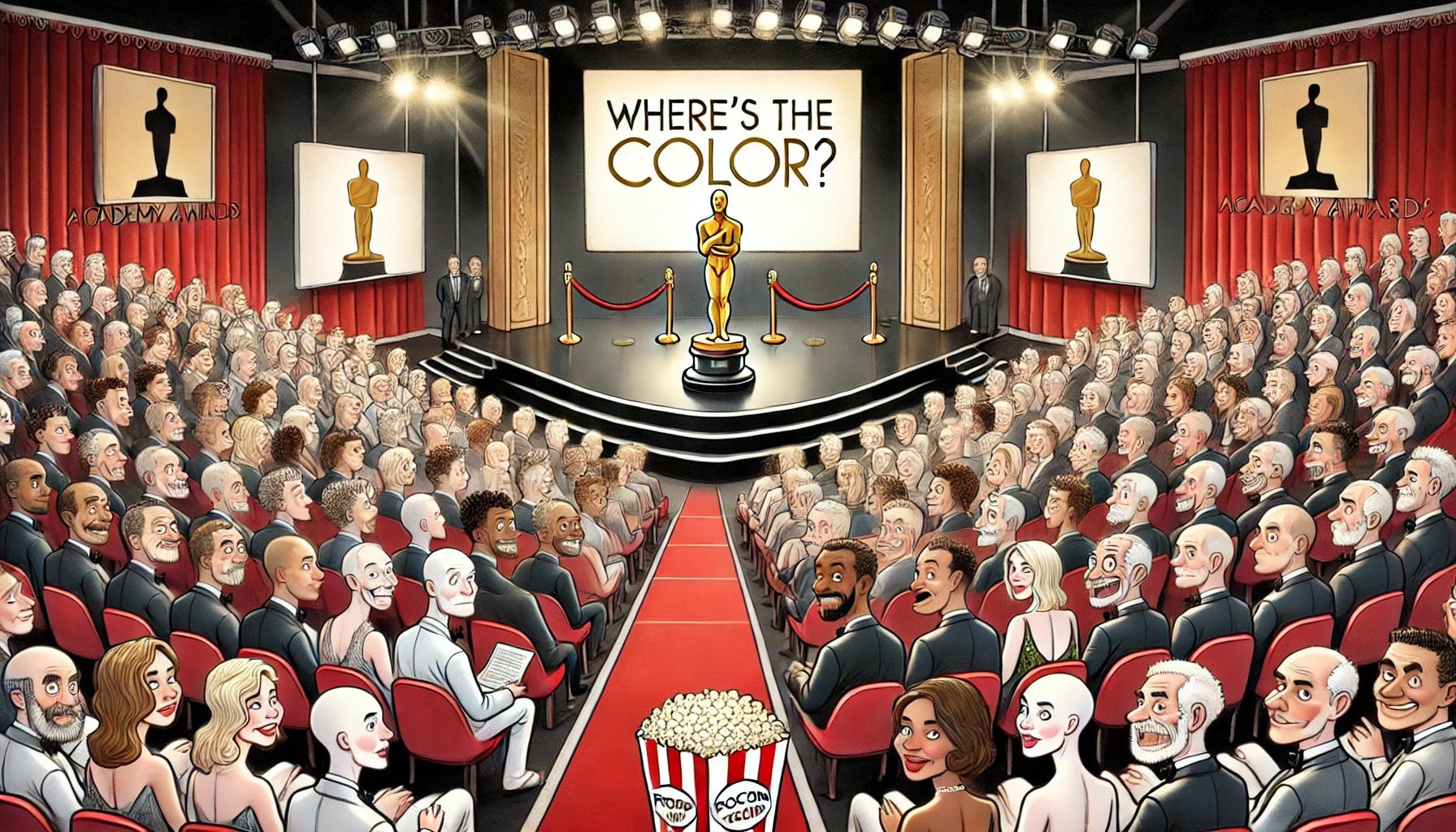
Dave showed up at my flat one evening, holding his phone like it contained the secrets of the universe.
“Winston,” he began, “why do Black actors still care about the Oscars? Isn’t it just Babylon in fancy clothes? Do you think they’re actually making a difference by showing up year after year?”
I chuckled, poured us both a drink, and leaned back. “Ah, Dave, the Academy Awards are a fascinating Babylonian spectacle—glamour, prestige, and plenty of exclusion dressed up as progress. But things are shifting, slowly but surely. Let’s decode this, shall we?”
The Origins: A Babylonian Institution
“The Academy Awards, or the Oscars, were founded in 1929,” I began. “They were designed to promote Hollywood’s ‘best’ and ‘brightest,’ but let’s be real—those definitions were written by white men for white men. For decades, Black actors were either ignored or confined to roles that reinforced stereotypes.”
Dave frowned. “Like Hattie McDaniel winning an Oscar for playing a maid in Gone with the Wind?”
“Exactly,” I said. “Her win in 1940 was historic, but she wasn’t even allowed to sit with her white co-stars at the ceremony. Babylon made sure her success was on their terms.”
The Emergence of Black Talent
“Fast forward a few decades,” I continued, “and we see the emergence of Black actors, writers, directors, and producers fighting to redefine Hollywood. Sidney Poitier broke barriers in the ’60s, becoming the first Black man to win Best Actor for Lilies of the Field. But even then, he was often cast as the ‘noble Black man,’ a character designed to make white audiences feel comfortable.”
Dave nodded. “So, even success came with strings attached?”
“Exactly,” I said. “But over time, Black creatives began to push back. Directors like Gordon Parks, writers like Lorraine Hansberry, and producers like Quincy Jones started carving out spaces for authentic Black stories.”
The Modern Movement: More Than a Seat at the Table
“Today, we’re seeing a wave of Black talent changing the game,” I said. “Directors like Ava DuVernay and Ryan Coogler are bringing powerful, nuanced Black stories to mainstream audiences. Writers like Jordan Peele are reimagining genres with films like Get Out, while producers like Shonda Rhimes dominate television with shows that centre Black experiences.”
Dave raised an eyebrow. “So, are they finally breaking Babylon’s hold?”
“Not quite,” I said. “The system is still deeply flawed. For every Black Panther or Moonlight, there’s an industry unwilling to fund or promote Black-led projects at the same scale as their white counterparts. But these creatives are proving that Black stories are not just marketable—they’re essential.”
Progress or Performative Inclusion?
“Let’s talk about the Oscars themselves,” I continued. “In recent years, we’ve seen more diversity—films like 12 Years a Slave and Moonlight winning Best Picture, and actors like Viola Davis and Mahershala Ali getting recognition. But the question remains: Is this real progress, or is it Babylon throwing crumbs to maintain its grip on the narrative?”
Dave tilted his head. “What do you mean?”
“Well,” I said, “when Babylon allows a few Black creatives into the spotlight, it creates the illusion of change while leaving the system largely intact. For every victory, there’s still a long way to go in terms of representation and equity.”
The Role of Black Creatives
“Some Black creatives use their platforms to challenge the system,” I said. “Think of Spike Lee, who’s spent decades calling out Hollywood’s racism, or Halle Berry’s historic Oscar speech in 2002, which highlighted systemic inequality. But speeches and awards alone won’t dismantle Babylon.”
“So, what’s the alternative?” Dave asked.
“Building independent systems,” I said. “Tyler Perry has created his own studio empire, while Issa Rae has used platforms like YouTube to tell authentic stories. The goal isn’t just to win Oscars—it’s to control the means of production.”
Decolonising Hollywood
“Imagine a decolonised Hollywood,” I said. “One where Black creatives aren’t just performers—they’re decision-makers. Where stories about Africa and the diaspora are told from our perspective, not through the colonial gaze. Where success isn’t measured by Babylon’s standards but by the impact on our communities.”
Dave looked intrigued. “So, it’s not just about winning awards—it’s about redefining success?”
“Exactly,” I said. “Because Babylon’s approval is a distraction. Real change happens when we stop seeking validation from the oppressor.”
The Takeaway
“The Academy Awards are a symbol of Babylon’s influence,” I concluded. “They can be a platform for progress, but only if used strategically. Black actors, writers, directors, and producers must decide: Are they working to bring down the system, or are they just playing along for a gold statue?”
Dave leaned back. “So, the revolution isn’t on the red carpet—it’s behind the camera?”
“Precisely,” I said. “Because true liberation won’t be televised—or awarded.”
#DecoloniseHollywood #BabylonExposed #ReclaimTheNarrative